Running a truck wash for your own fleet or opening it to the public
A V-Max wash system can serve a private fleet or a paying public, and the two uses call for different priorities on the same equipment.
September 23, 2026 · 4 min read
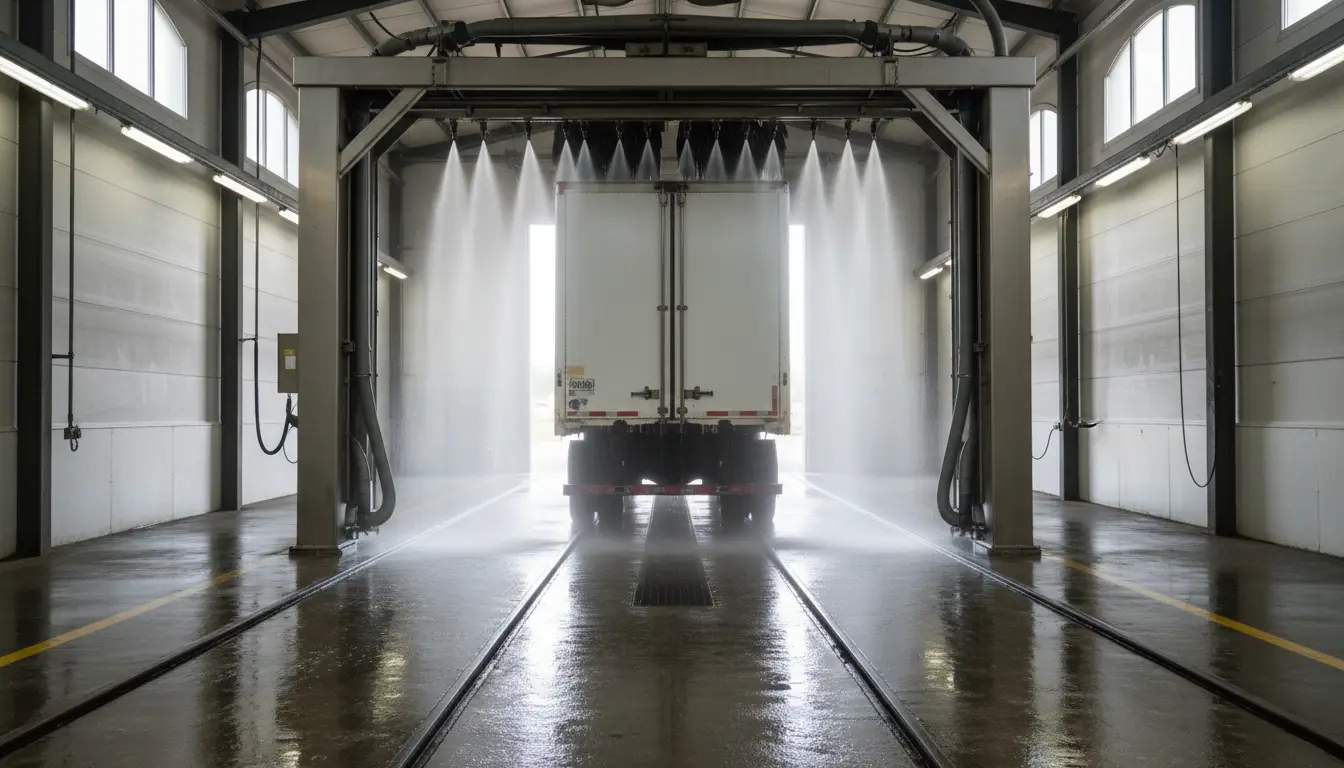
There are two very different reasons an operator ends up looking at a large vehicle wash system, and they lead to different equipment decisions even though the underlying machine might be the same. One reason is keeping your own fleet clean and presentable without sending trucks out to a wash you do not control and cannot schedule around your own routes. The other is building a retail facility that takes paying customers with vehicles ranging from a pickup with a trailer to a full tractor-trailer. Belanger's V-Max is built to cover both of those, but which features actually matter to you depends heavily on which of those two businesses you are really running, and it is worth being honest about that before you spec the equipment.
What the V-Max actually does in a few minutes
The V-Max is a touch-free automatic system built around an overhead gantry rather than a fixed tunnel, which means the vehicle stays in one place while the wash equipment travels over and around it instead of pulling the truck through a line. It comes in three system configurations and can wash a full range of large vehicles, from a thirty-foot dump truck up to a seventy-five-foot tractor-trailer, in as little as three to six minutes, which is a significant amount of vehicle to clean in that short a window.
Sizing is handled automatically through sonic vehicle sizing, so the same system adjusts itself to a dump truck one cycle and a tractor-trailer the next without anyone climbing down to reprogram it in between runs. Combined with greased-for-life bearings and a build using aircraft-grade aluminum and high-density plastic components, the equipment is meant to hold up to constant daily cycling on a fleet schedule rather than the occasional wash a retail location might see on a slow day.
Running it for your own fleet
For an operator washing their own trucks, the V-Max lets up to four different wash package options run on the same system, which matters when a fleet includes everything from daily local trucks to long-haul tractor-trailers that need a different level of clean depending on the season, the route, and how much road grime a truck has picked up since its last pass through. A truck that only runs local deliveries in dry weather does not need the same cycle as one that just came off a week of winter highway miles.
Optional add-ons like an undercarriage wash and a spot-free rinse stage matter more for a fleet than they might for a retail-only setup, since a fleet's own reputation on the road rides on how clean the trucks look leaving the yard every morning, and undercarriage buildup is exactly the kind of thing that goes unnoticed until it becomes a bigger maintenance issue on the truck itself.
Opening it to paying customers
The same system supports a Point of Purchase interface, which is what turns a fleet wash into a retail large vehicle wash facility that any driver can pull into and pay for a cycle without an attendant running it manually. That is a real second business built on top of equipment you may already be running for your own trucks, provided the volume passing through and the space available justify adding a public-facing side to what started as an internal operation.
The four programmable wash packages work the same way here as they do for a fleet, giving a paying customer a choice between a quick cycle and a more thorough one, which matters for a facility trying to serve everything from a local box truck stopping in for five minutes to a cross-country tractor-trailer driver who wants the full wash before the next leg of a long haul.
Tracking it after the sale
The V-Max's E-300 program interface manages washes off-site over the internet, so an operator can track wash frequency and which packages are actually being selected without standing in the bay watching every cycle happen in person. For a fleet, that is a real record of how often trucks are actually getting washed rather than a guess based on memory. For a retail operation, it is a look at which wash packages customers are actually willing to pay for, which is useful information when it comes time to adjust pricing, add a package, or drop one that nobody selects.
- Guide rail and pumping stations
- A water softener
- A four button wash selector panel
- Illuminated entry signage
- A gas fired boiler
- A complete backroom with the machine control center, solution delivery module and E-300 programmer
Fleet or retail, the maintenance question doesn't change
Whichever business you are actually running, a system that washes multiple vehicles a day, every day, needs the same kind of ongoing attention as anything else in the bay: pumps, boiler, and the backroom controls all see heavy use whether the trucks belong to you or to a paying customer. Skipping that maintenance because the wash count looks fine one month is how a system that was reliable for years starts having an unreliable one.
DMI sells and services the V-Max for operators across the Tri-State, whether the goal is keeping your own fleet looking right or building a retail wash for large vehicles. Call (701) 237-6606 to talk through which configuration fits your yard.
DMI Car & Truck Wash Systems, (701) 237-6606
Call (701) 237-6606More articles
Winter at a self-serve bay: what fails first when it hits 20 below
When it drops below zero in Fargo, the failures in a self-serve bay tend to show up in almost the same order every year.
Touch-free, soft-touch or both: choosing an in-bay automatic
Touch-free, soft-touch and combination in-bay automatics each trade something for something else, and the right choice depends on your vehicles and your climate.